Wall art is one of the best niches in print-on-demand — high margins, universal appeal, and customers who actually care about what ends up on their walls. The catch is that almost every POD company offers wall art, but very few are actually built for it. So we ranked these on what matters: product range, print quality, fulfillment speed, and how specialized each one really is in this category.
(Fair warning: we made the list ourselves. We'll let you be the judge of where we landed.)
1. Printseekers
Best for: Wall art specialists — artists, Etsy sellers, and brands who want the widest product variety in the category
We'll start with ourselves, and we'll try to be straight about why we put ourselves first — and where we fall short.
Printseekers was built specifically around wall art. Not an apparel platform that expanded into prints; a production partner whose entire catalog starts and ends with what goes on a wall. That focus shows in the product depth.
Here's what Printseekers actually offers:
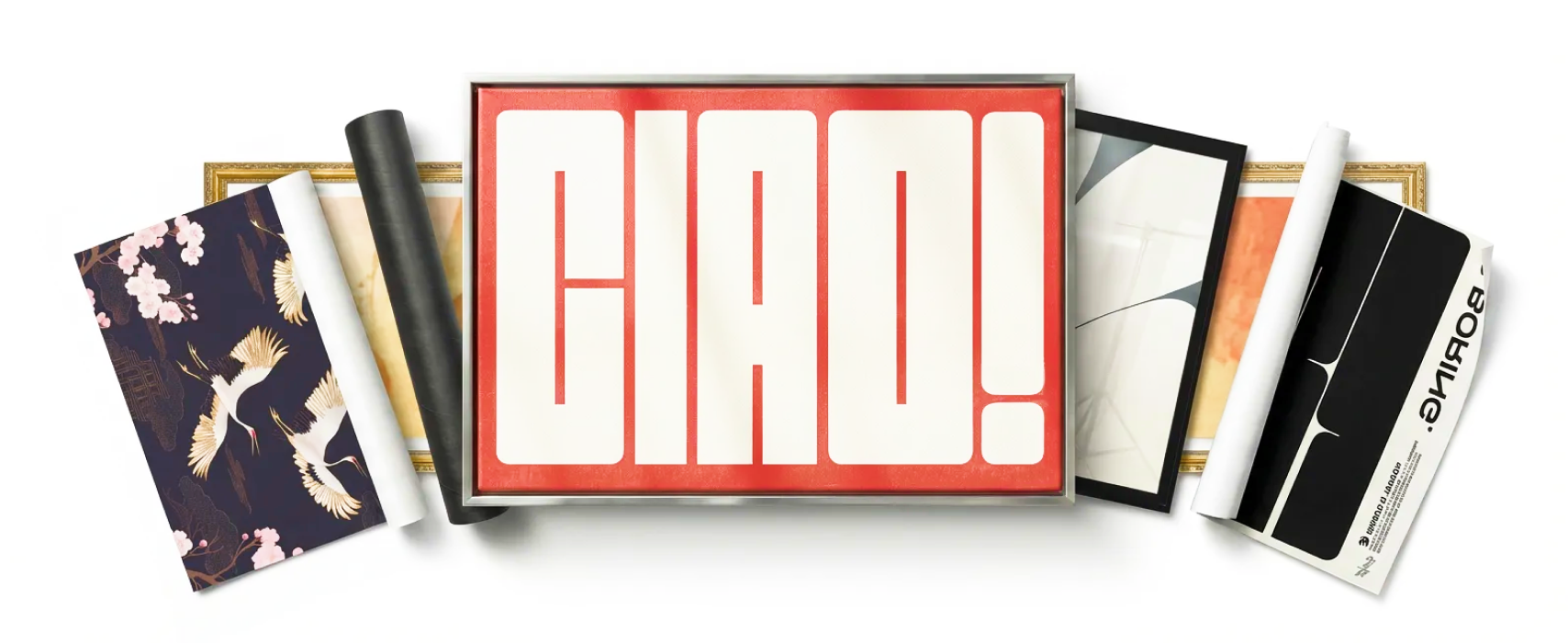
The catalog covers everything wall art can be: canvas (stretched, gallery, rolled, multipanel), framed canvas in seven frame finishes, posters across four paper types, framed posters, metal prints, archival fine art prints, and wallpaper in peel & stick and traditional — plus the largest sizes most platforms won't touch.
The gold and silver frames, the neon options, the wallpaper — these are variants that let you build a catalog that looks like it came from a boutique brand, not a generic fulfillment house. We also offer a dedicated personal manager for every partner, white-label shipping, and Shopify and Etsy integrations.
Pros:
- Deepest wall art catalog in POD — more frame types, more paper types, more product formats than anyone on this list
- That means real niche flexibility: neon frames for pop-art prints, gold and silver for fine-art and luxury stores, four poster paper types so you can price-tier the same design from budget to premium.
- Wallpaper (peel & stick + traditional) — almost nobody else in POD does this at scale
- Largest size options in the category
- White-label shipping: your brand on every box
Cons:
- The fulfillment dashboard isn't as polished as Printful's or Gelato's — there's a slight learning curve, and setup takes more effort than plug-and-play platforms
- Fewer integrations
- Newer to the market than the industry veterans, which means less third-party review data
Who it's for: If wall art is your primary product and you want the most distinct, premium variants available — framed canvas in multiple finishes, wallpaper your competitors don't carry, metal prints most stores haven't discovered yet — this is what we built.
2. Gelato
Works great for: Sellers with international audiences who need fast, localized delivery
Gelato doesn't manufacture anything in-house. It routes orders to whichever of its 140+ print partners sits closest to the buyer — across 32 countries. For a wall art seller shipping to Germany, the UK, the US, and Australia simultaneously, that's a genuine structural advantage. Local production means shorter shipping windows, lower cross-border friction, and a more sustainable footprint.
The wall art catalog is solid: canvas prints, framed posters, metal prints, some acrylic options. Print quality on posters and framed prints is consistently praised — one hands-on reviewer called the paper stock and framing on framed posters "genuinely excellent." The interface is also notably clean and beginner-friendly, which matters when you're just getting started.
The honest tradeoff with any network model: since different orders may route to different facilities, quality can vary slightly between partners. Gelato manages this well, but sampling across products and sizes before committing is still non-negotiable.
Pros:
- Local production in 32 countries — fastest international delivery in this list
- Strong wall art output, especially framed posters and canvas
- Very clean, beginner-friendly interface
- Shopify, Etsy, WooCommerce, Amazon, and more
- Genuinely good sustainability story — local production means less freight
Cons:
- Network model means some quality variation between facilities
- Fewer frame variants and no wallpaper compared to wall art specialists
- Pricing can run slightly higher than aggregators like Printify
- Some branding and personalization features are locked behind paid plans
3. Printful
Works great for: Sellers who want in-house reliability and brand-quality packaging across a mixed catalog
Printful is the most established name in POD. In-house production across North America and Europe. Over 100 million items delivered since 2013. The branding options — custom inside labels, packing inserts, outside labels — are the best in the category and genuinely useful if you're building a brand rather than just a store.
For wall art, Printful covers the essentials: canvas prints, framed posters, enhanced matte options. Quality is reliably high because everything is made in-house and they've had years to tighten production. It's not the most innovative wall art catalog, but what's there works, and the consistency is real.
The honest limitation for wall art sellers: Printful is primarily an apparel platform, and the wall art catalog reflects that. Frame options are limited, there's no wallpaper, sizing is shallower than specialists. Base prices are also on the higher end — you're paying for the brand infrastructure.
Pros:
- In-house production across multiple facilities = consistent, reliable quality
- Excellent Shopify, Etsy, WooCommerce integrations
- Large user community and strong documentation
- Design Maker tool is genuinely useful
Cons:
- Among the higher base prices in the category
- Wall art catalog is shallower than specialists — fewer frame options, no wallpaper
- Primarily an apparel platform; wall art feels secondary
- No built-in marketplace — you drive all your own traffic

4. Printify
Works great for: Sellers who want the largest catalog and the most competitive base pricing
Printify is an aggregator — it doesn't manufacture anything, but connects you to many print providers across multiple facilities worldwide. The result is 1,000+ products and some of the lowest base prices in POD, because suppliers compete with each other on the platform.
For wall art, the provider network covers canvas, posters, framed prints, and more. The Premium plan ($39/month, or $24.99/month billed annually (prices may vary & change)) unlocks up to 20% discounts across the catalog, which pays for itself quickly at any real volume. The catalog breadth is genuinely unmatched.
The catch — and it's a real one — is that quality varies significantly depending on which provider fulfills a given product. Printify has introduced "Printify Choice" to surface recommended partners, but you still need to sample key SKUs, lock in preferred suppliers, and stay on top of who's actually fulfilling your orders. The stories from sellers who skipped that step are not fun to read.
Pros:
- Most competitive base pricing, especially at the Premium tier
- Wide range of wall art providers to compare and choose between
- Shopify, Etsy, WooCommerce, and more integrations
Cons:
- Quality varies between print providers — sampling before scaling is mandatory, not optional
- Network model means less consistency than in-house producers
- Wall art isn't a focus — the catalog is broad but not deep in this category
5. Prodigi
Works great for: Fine art photographers and illustrators where print quality is the product
Prodigi is the most print-quality-focused platform in this list. Their core business is fine art giclée printing — archival papers, accurate color reproduction, handmade framed canvas with floating-frame construction — and the reviews back it up. One side-by-side comparison described the difference between Prodigi and Printify as "obvious."
The wall art catalog is deep: fine art prints on museum-quality paper, stretched and framed canvas. Everything ships white-label with no Prodigi branding. UK, EU, and US production in-house, supplemented by 50+ print partners.
Where they're honest limitations: production windows can be longer on custom framed work, and their catalog outside wall art and prints is narrower.
Pros:
- Best raw print quality in this list — particularly strong for photography and fine art
- Fine Art Trade Guild approved
- Beautiful framed canvas options including floating-frame construction
- Fully white-label, no Prodigi branding on packaging
- UK, EU, and US production
Cons:
- Production times on the longer side, especially on custom framed products
- Narrower catalog outside of wall art — apparel and gifting categories are underdeveloped
- Steeper learning curve for beginners compared to Printful or Gelato
- Less name recognition means fewer community resources and tutorials

6. Redbubble
Works great for: Artists who want massive marketplace reach with zero setup
Redbubble is one of the most visited art marketplaces in the world, with a community of independent artists that has been building since 2006. For wall art specifically, art prints are among the platform's top-performing categories, alongside stickers and apparel.
The model is simple: upload your design, apply it to 60+ products including canvas prints, framed prints, metal prints, and posters, set your markup percentage above Redbubble's base price, and you're live. Redbubble handles printing, shipping, and customer service entirely. No store setup, no integration work, no upfront cost.
The tradeoff is the usual one with marketplaces: lower margins, no customer data, no brand control, and you're building Redbubble's audience more than your own. Competition is also intense — the platform is large enough that ranking organically takes genuine work. For wall art sellers, it works better as a supplementary channel than a primary business.
Pros:
- Massive built-in audience actively buying wall art
- Zero setup, zero upfront cost
- Wide product range applied instantly to a single design upload
- Artist sets their own markup percentage above base price
- Handles fulfillment, returns, and customer service entirely
Cons:
- Thin margins — Redbubble's base prices leave limited room, especially once fees are factored in
- Very high competition among artists; organic discovery takes real effort
- No customer data ownership, no brand control
7. Society6
Works great for: Design-forward artists who want a curated marketplace with a home decor aesthetic
Society6 has a distinct visual identity in the POD marketplace world — it skews toward contemporary, design-forward work: botanicals, abstract prints, retro patterns. If your work fits that aesthetic, the platform's audience is genuinely aligned with it. It's also broader than most people expect: beyond wall art, the catalog extends into furniture, rugs, shower curtains, and lifestyle products that few POD platforms reach.
The honest context in 2026: Society6 removed the ability for artists to set their own margins in 2025, standardizing earnings to a fixed 5–10% of net sale per product. That's a meaningful change. Combined with the usual marketplace dynamics — frequent sitewide promotions, high competition, no customer ownership — the economics are tighter than they used to be.
It's still a real platform with a real audience, and for artists whose work fits the aesthetic it's a low-effort channel. Just go in knowing the margin picture clearly.
Pros:
- Distinct, design-forward community with genuine art buyers
- Product range beyond wall art — furniture, rugs, lifestyle items
- No upfront cost
- Curated feel that can give legitimacy to a young brand
Cons:
- Fixed 5–10% artist earnings since 2025 — limited income ceiling
- Frequent sitewide promotions compress effective margins further
- No customer data ownership
- High competition within the platform
- Less traffic than Redbubble
8. Gooten
Works great for: Growing businesses that want a network fulfiller with tighter quality control than Printify
Gooten sits in a different position from most of this list: no subscription fees, no transaction fees, pay only per item produced. For sellers who've moved past the hobbyist stage but aren't ready to commit to a monthly plan, that model is genuinely useful.
The network covers multiple manufacturing partners across many locations, with most of the production being US-based. Wall art options include canvas, framed prints, metal prints, and acrylic — solid coverage of the core formats. The catalog is intentionally tighter than Printify's, which Gooten positions as an advantage: fewer providers means easier quality management. For higher-volume sellers, the VIM (Very Important Merchant) program offers quarterly business reviews, sample credits, and direct access to the operations team.
Like any network model, output quality varies between partner facilities. Sampling before scaling remains essential.
Pros:
- No monthly subscription fees — pay per item only
- Tighter provider network than Printify = more manageable quality control
- Good wall art coverage: canvas, framed, metal, acrylic
- VIM loyalty program for scaling sellers
- Over 70% US-based production
Cons:
- Smaller catalog than Printify — fewer products and providers to choose from
- Quality still varies between partner facilities
- Less name recognition and fewer tutorials than the top-tier names
- No built-in marketplace — you drive all your own traffic
Who it's for: Sellers who want a Printify-style network model but with less complexity, no monthly fees, and tighter quality control — particularly those selling primarily to US customers.
One thing to know in 2026: Gooten was acquired by Taylor Corporation in late 2025, and the transition period brought operational disruptions that frustrated some long-time sellers. The fundamentals described above still apply, but check recent reviews and sample carefully before committing — more than you would with anyone else on this list.
So who's actually right for you?
It genuinely depends on what you're building.
You're serious about wall art as a primary category and want the deepest catalog — framed canvas in the most finishes, wallpaper, metal prints, fine art paper types — that's what Printseekers is built for. We're biased, obviously. But the product range is real.
You're selling internationally and fast delivery matters more than depth — Gelato's local production network is hard to beat. Thirty-two countries, local fulfillment, and a clean interface that gets you live quickly.
You want rock-solid in-house consistency and strong branding tools across a mixed apparel-plus-wall-art catalog — Printful remains one of the safest bets in the industry. You pay a premium, but the reliability is real.
You need the widest catalog at the lowest base prices — Printify, but do your provider research first. Seriously.
Print quality is the product — you're a photographer or fine art illustrator and you need the physical object to be exceptional — Prodigi is genuinely excellent and worth testing.
You want passive reach with zero setup — Redbubble and Society6 are real platforms with real audiences. Go in knowing the margin picture and treat them as supplements, not a business.
The best move before committing to anything: order a sample. Every platform above will ship you a test product. What you hold in your hands will tell you more than any ranking will.
Printseekers is a print-on-demand fulfillment company built around wall art. We handle production and shipping ourselves — no middlemen. If you want to see what we're about, start here.