


If you sell print-on-demand products to customers in Europe, your e-mail has probably filled up with two acronyms lately: PPWR and EPR. Usually attached to a vague warning and a sales pitch.
In the simplest possible terms: the EU has changed the rules around the packaging your products arrive in.
For an example, if you sell a poster to someone in Germany and it arrives in a cardboard tube, somebody has to take responsibility for that packaging, including reporting it and helping pay for its recycling.
That is where PPWR and EPR come in.
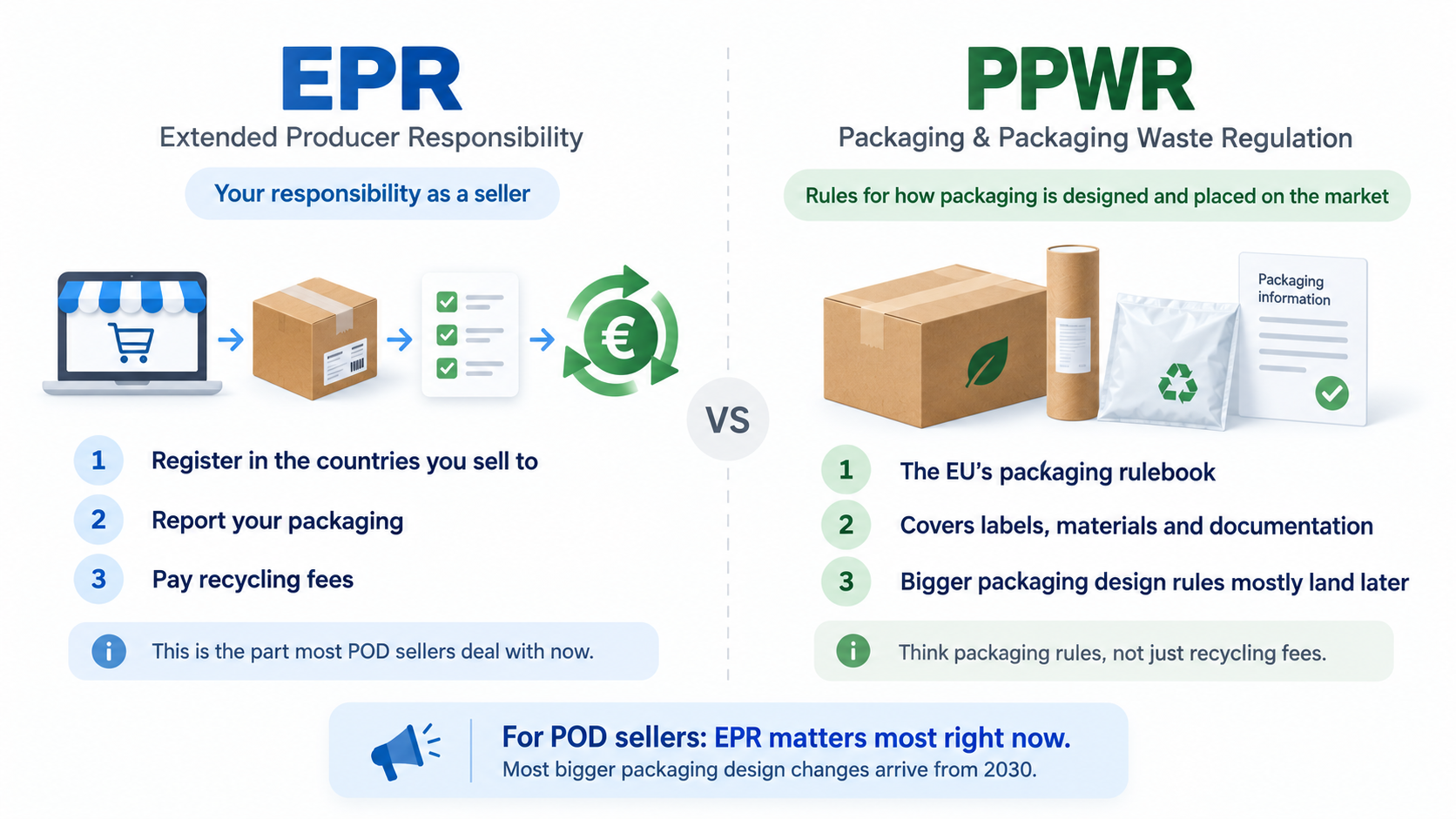
PPWR is the EU’s new packaging rulebook. EPR is the part sellers are most likely to actually deal with: registering in the countries they sell to, reporting packaging volumes and paying recycling fees.
And yes, this can still apply when a print on demand company prints, packs and ships the order for you.
A quick disclaimer first: we're a print on demand company, not a law firm. All the used sources are linked below so you can check it yourself.
The Summary
- The EU's new packaging law, the PPWR, has applied since August 12, 2026. It's the biggest overhaul of EU packaging rules in about 30 years.
- It was not postponed, despite a lot of pressure to do so.
- For most POD sellers, the part that matters today is EPR: registering in the EU countries you sell to, reporting your packaging, and paying a small recycling fee.
- Using a print on demand company usually doesn't move that responsibility off you. If the product is sold under your brand, you're typically the "producer."
- Most of the big design rules (recyclability, recycled content, empty space in parcels) don't kick in until 2030, and those mostly land on whoever makes the packaging.
So no, you probably don’t need to redesign every box tomorrow.
But you might need to do some paperwork.
What actually happened
On August 12, 2026, the Packaging and Packaging Waste Regulation (Regulation (EU) 2025/40) started applying across the EU. It replaces the old packaging directive from 1994, which is why "biggest overhaul in 30 years" isn't marketing exaggeration for once.
The important shift is legal, not visual. The old rules were a directive, which each country translated into its own national law, in its own way. The PPWR is a regulation, so the same rulebook applies directly in all 27 member states. The Commission's pitch is that one common set of rules replaces a messy patchwork and makes cross-border selling simpler over time.
Was it delayed?
No. Business groups pushed hard for more time. Eurochambres asked for a two-year postponement as late as July 2026. The Commission held the date, and as of early September no act postponing it had been published.
What the Commission did do is publish an updated FAQ in August that softens the landing. According to Lappa's summary of it, authorities are expected to flag problems and give businesses time to fix them before pulling products. Packaging made before August 12 also doesn't need to be thrown away or relabelled. That's not a reason to ignore it. But it's a reason not to panic.
PPWR vs. EPR (the two acronyms people mix up)
This is where most of the confusion starts.
PPWR stands for Packaging and Packaging Waste Regulation. Think of it as the big EU rulebook covering packaging: what can go into it, how recyclable it needs to be, how it should be labelled, how much empty space a parcel can have and what documentation should exist behind it.
EPR, or Extended Producer Responsibility, is more specific.
The basic idea is simple:
If you put packaging into a country, you help pay for dealing with that packaging after the customer throws it away.
In practice, that can mean:
- Registering as a producer.
- Reporting how much packaging you place on the market.
- Joining or paying into a recycling scheme.
- Paying fees based on that packaging.
EPR itself isn’t new. Countries such as Germany and France have already required it from online sellers for years.
What PPWR does is create a much more consistent EU-wide framework around packaging — although you still deal with national EPR systems country by country.
So unfortunately, this did not turn into one magical EU registration form.
What applies now vs. later
August 12, 2026: paperwork and registration:
This is when the packaging paperwork kicks in: declarations of conformity that prove the packaging meets the rules, plus limits on heavy metals and on PFAS in food-contact packaging. The EPR registration rules start now too. For POD sellers, the EPR part is what matters. The PFAS rules only cover food packaging, so they don't affect wall art.
From 2028: one label for all of Europe
A harmonised sorting label will be used across the EU, so customers know how to recycle packaging wherever they live. This one mostly lands on your POD partner, since they print and pack your orders.
From 2030: the packaging itself changes
This is when the bigger design rules arrive:
- Packaging must be recyclable.
- Plastic packaging must contain recycled plastic.
- E-commerce parcels can be at most 50% empty space.
- Some single-use plastic packaging is restricted.
Again, this is mostly your POD partner's job, since they choose the packaging.
The takeaway: August 2026 is mainly about paperwork and registration. The "redesign your box" moment comes in 2030.
The Weird Part: Your POD Company Ships It, but You May Still Be the “Producer”
This is probably the most important part of this article:
If you sell products under your own brand, you can still be considered the producer for EPR purposes even when a POD company physically prints and ships the order.
The easiest way to split it is:
Your POD partner:
Chooses the box, tube, protective materials and other packaging. They therefore handle much of the actual packaging design and production-side compliance.
You, the seller:
Sell the product under your brand to the end customer. That can make you responsible for EPR registration, reporting and fees.
The law is less interested in who taped the box shut than in who put the packaged product onto that market.
The Hlaw cares about who sells the product to the end customer, not who taped the box shut.
If the product goes out under your brand, to your customer, from your store, you're typically the "producer" under the PPWR and each country's EPR rules. Etsy's own Seller Handbook says the same thing: sellers shipping to EU buyers may count as producers and need to register, report and pay fees themselves.
That's true whichever print on demand company you use, us included.
The easiest way to think about it is to split the job in two:
- The packaging itself (materials, design, documentation) is generally handled by your POD partner, because they choose and buy the box.
- Registering, reporting and paying EPR fees in each country is usually on you, because it's your brand and your customer.
What This Means for Etsy sellers
Etsy has already started building EPR compliance into its seller tools.
According to its Seller Handbook, sellers may need to register in countries they ship to, report packaging quantities, join recycling schemes and — depending on the situation — appoint authorised representatives.
Etsy currently accepts EPR registration numbers for France, Germany and Spain, with more expected to follow.
They can be added under:
Shop Manager → Finances → Legal and tax information → EPR Registrations
Etsy is also pushing for simpler requirements for small businesses, so this is an area worth keeping an eye on.
What About Shopify or Your Own Store?
Shopify isn’t going to stop your checkout and ask whether you remembered your German packaging registration.
The legal obligation can still exist.
The useful part is that EPR registration generally isn't tied to an individual sales channel.
If you're properly registered in a country, you don't normally need one registration for Etsy, another for Shopify and another for your own website.
The registration follows the producer, not the storefront.
And If You Mainly Sell in the US?
PPWR only matters when packaging enters the EU market.
So if your customers are almost entirely in the US, this specific regulation probably isn't keeping you awake tonight.
But the US is moving in a similar direction.
Packaging EPR laws now exist in California, Colorado, Maine, Maryland, Minnesota, Oregon and Washington, although thresholds and exemptions differ by state.
The UK Has Its Own Rules
The UK isn't part of PPWR.
It has its own packaging EPR system, with much higher thresholds than some EU schemes.
Businesses generally only fall into the UK system if they are established in the UK, handle more than 25 tonnes of packaging per year and have turnover above £1 million.
That puts many smaller POD stores below the threshold.
Larger sellers should check the UK government guidance directly.
The Authorised Representative Problem
This is the part that can make cross-border compliance more expensive.
Under PPWR, a business selling directly into another EU country may need an authorised representative there to handle certain EPR obligations.
Imagine selling into ten European countries and potentially needing local compliance arrangements in each one.
You can see why sellers aren't thrilled.
There is a proposal to postpone this particular requirement for EU-based sellers until 2035, but that proposal should not be treated as law yet.
For now, check the rules in the countries where you actually sell rather than assuming one answer applies everywhere.
Two Other EU Acronyms You’ll Probably Run Into
Because apparently two weren't enough.
GPSR
The General Product Safety Regulation has applied since December 13, 2024.
It covers product-safety requirements such as responsible-person information and clearer manufacturer/contact information on listings.
We already wrote a full guide to GPSR for print on demand sellers if you need that one.
EUDR
The EU Deforestation Regulation begins applying from December 30, 2026.
For wall art, wood is the obvious connection — particularly wooden frames.
Printed pictures themselves were removed from the scope in a December 2025 amendment.
Most of the major compliance work falls on whoever first places the relevant wood product onto the EU market, although businesses further down the chain can still have obligations.
What Should You Actually Do?
Don't start with all 27 countries and a panic-induced spreadsheet.
Start with where you actually sell.
- Export your orders from the last year. See which EU countries you're genuinely shipping to.
- Ask your POD provider what they already cover. Find out whether they hold relevant registrations and whether they can provide packaging weights for reporting.
- Check your EPR obligations in your biggest markets. Germany, France and Spain are obvious countries to investigate if you sell there, particularly because Etsy already requests registration numbers for them.
- Add existing registration numbers to your marketplaces.
- Check whether an authorised representative is required for your setup.
- Keep packaging records. You'll need actual numbers when reporting.
- Leave the 2030 panic for 2030. The immediate job is understanding your registration and reporting obligations.
FAQ
Has PPWR been postponed?
No. The regulation started applying on August 12, 2026. There have been proposals and discussions around delaying individual requirements, but PPWR itself was not postponed.
Do I still need EPR if I use print on demand?
Potentially, yes. If you're selling products under your own brand into an EU market, using a fulfillment company does not automatically remove your EPR obligations.
Does PPWR apply in the UK or US?
No. The UK and several US states have their own packaging EPR systems.
Do I need new packaging immediately?
Not necessarily. Many of PPWR's major packaging-design requirements don't arrive until later, particularly from 2030.
Is this legal advice?
No. This is our plain-English reading of the current rules and official guidance. Your exact obligations depend on where your company is established, where you sell and how your business operates.




.png)


