


Decorating a wall is one of the few acts that is equal parts practical and personal - and what the wall art market confirms every year - is that the impulse to put something meaningful on a wall never fully disappears. It just gets filtered by budget, practicality, and how much effort someone is willing to put in.
Posters are where that impulse is most accessible. Not because they’re cheap - though they can be - but because they’re the format that removes every barrier between a buyer and a piece of art on their wall. No framing required, no premium commitment, no weeks-long wait. For print on demand sellers, that accessibility is a commercial advantage as much as a creative one.
This guide covers what actually matters: which paper to choose, what designs perform, how to prepare files correctly, and how to position posters in a way that builds a real store.
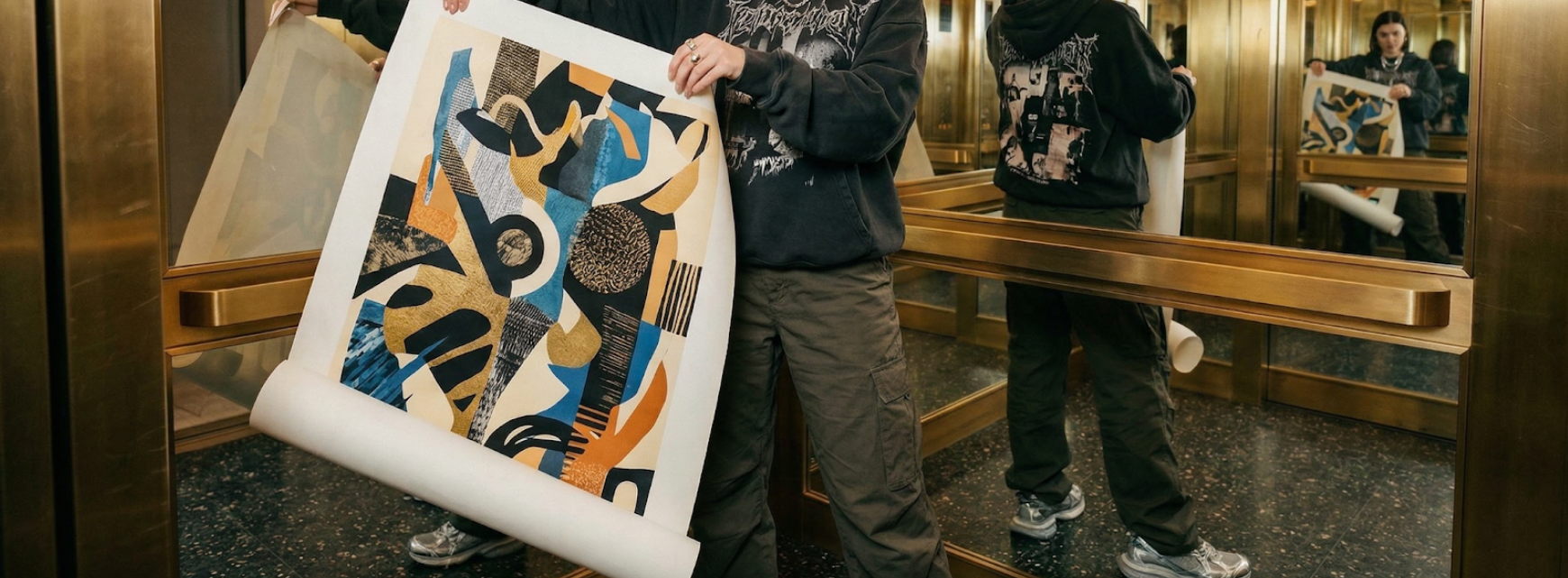
What Print on Demand Posters Are
Nothing is printed until a customer buys. When an order comes in, the design gets printed on the selected paper, rolled in tissue paper, packed into a tube, and shipped directly to the buyer. No inventory, no minimum order, no risk if a design doesn’t sell.
Printseekers prints all posters on the Epson SureColor SC-P9500 with a 12-colour inkset - archival-quality output with accurate colour reproduction across the full paper range. All posters are giclée printed, which means the same production standard used for fine art reproductions. Colours stay vivid and details hold over time.
Why Posters Scale Better Than Almost Anything Else
Production costs are low, which leaves room for strong margins even at competitive prices. Shipping is cheap - a rolled poster in a tube costs significantly less to send than canvas or framed art, especially internationally. And because the same design can be listed across multiple paper types and sizes, one artwork becomes a large catalog without additional creative work.
Demand is broad too. Posters sell in music, travel, sports, gaming, anime, typography, fine art, photography, botanical, interior decor - almost every customer base that buys anything online has a subset that buys wall art. The question is not whether to sell posters. It is which paper to offer them on, and which designs to lead with.

What Designs Actually Sell
This is the part most guides skip. The paper and file specs matter, but the design is what determines whether a listing converts or sits dormant. A few patterns hold consistently across the poster market.
Specificity outperforms generality. A golden retriever illustration sells better than a generic dog print. A poster of a specific city neighbourhood sells better than a city skyline. The more a buyer feels the design was made for them, the more likely they are to purchase without comparison shopping.
Trends move fast, but evergreens compound. Trend-driven designs - a colour palette that’s having a moment, an aesthetic that’s all over social media - can generate spikes in traffic. But timeless designs - botanical illustrations, architectural prints, typographic quotes, abstract colour fields - keep selling for years without needing to be refreshed. The best catalogs have both.
Style consistency builds stores. A buyer who purchases one poster from a store where everything shares a visual language will come back. A store that sells unrelated designs in unrelated styles builds no loyalty and no brand recognition. The constraint of a consistent aesthetic is actually a commercial advantage.
AI-generated artwork is worth approaching carefully. It can produce compelling results quickly, but artifacts that are invisible on screen - repeating textures, broken gradients, over-sharpened edges - become visible on paper. Always check at 100% zoom before uploading. If something looks slightly off on screen, it will look worse in print.

Choosing the Right Paper
Paper determines whether a poster feels cheap, solid, or gallery-level. Most customers won’t read the specs, but they will notice thickness, texture, and colour depth the moment they unroll it. Getting this right is where the product is either justified or undermined.
Printseekers offers five paper types. Each is a different product for a different buyer.
Standard Matte - Starting from $4.10
The lightest and most affordable option. Smooth, flat, no glare. It feels similar to a classic retail poster - which is both its limitation and its strength. Colour reproduction is clean but not deep. Blacks are soft rather than rich. Best for trend-driven designs, student decor, and buyers who rotate their wall art frequently. The right paper for high-volume stores where price is the primary driver.
Advanced Matte - Starting from $4.40
Noticeably thicker and more rigid than Standard. The same glare-free finish, but colours read deeper and the product feels more considered in hand. This is the paper that works across almost every design category - illustrations, photography, abstract art, botanicals, interior decor. If you’re unsure where to start, start here. It sits at a price point that justifies mid-range retail without requiring a premium brand story to back it up.
Matte Photo Paper - Starting from $4.70
Engineered for image clarity. A specialised coating keeps ink closer to the surface, producing sharper detail and stronger contrast than standard matte. The finish is still non-reflective, but the image reads as more precise and defined. This paper prioritises visual sharpness over thickness. The right choice for photography stores, travel prints, portrait art, and designs where fine textures and gradients are doing the work.
Glossy Photo Paper - Starting from $4.70
A reflective coating that makes colours appear more saturated and contrast stronger. Blacks are deeper, highlights brighter. Visually the most striking option for bold graphics, pop art, and colourful work. The trade-off is glare - in bright rooms or near windows, reflections are visible from certain angles. Glossy suits specific aesthetics and commercial spaces rather than general home interiors. Know your buyer before defaulting to it.
Fine Art Paper - Starting from $5.70
The heaviest and most textured paper in the range. A subtle surface that gives prints a gallery-quality feel - closer to a fine art print than a poster. Colours appear softer and more nuanced. Depth over contrast. This paper signals quality before the customer reads anything. It is for stores positioning themselves as art brands rather than decor shops. It also frames exceptionally well, which makes it a natural pairing with framed poster listings.

Archival and Giclée: Two Terms Worth Using in Your Listings
Archival means the materials are designed to resist fading, yellowing, and colour shift over time under normal display conditions. Giclée refers to high-quality inkjet printing using archival inks on professional paper. Both apply to every Printseekers poster.
Using these terms in listings signals that the product is not disposable decor. For fine art, photography, and premium-positioned stores, they justify the price and attract buyers who are specifically looking for quality that lasts.
Sizes and Formats
Posters are available from 15×15 cm (6×6”) up to 200×100 cm (80×40”). Large formats are where posters shine as a product - they create strong visual impact while remaining lightweight and cheap to ship. Unlike canvas, even oversized prints stay affordable to deliver internationally.
Offering multiple sizes from the same design increases conversion because buyers can choose what fits their space without leaving your store. Custom sizes are available on request - contact the Printseekers sales team for aspect ratios outside the standard range.
Preparing Your Design Files
Requirements
- Format: JPEG, JPG, or PNG
- Resolution: 300 DPI - mandatory for sharp output at any size
- Colour profile: RGB (sRGB) - never CMYK, converting later causes unpredictable colour shifts
- File size: maximum 2 GB
- Dimensions: Files must be submitted true to size - match the exact print dimensions
Colour Accuracy
Screens and printers don’t reproduce colour the same way. Designing in sRGB from the start gives the closest approximation to the printed result. For designs where colour precision matters - brand colours, subtle gradients, tonal photography - order a sample before listing. The sample tells you things no screen preview can.
Packaging and Shipping
All Printseekers posters ship rolled in tissue paper inside a sturdy, branded tube. This protects the print during transit and keeps shipping costs significantly lower than canvas or framed alternatives - an advantage that compounds on international orders where shipping cost can make or break a margin.

Frequently Asked Questions
Which paper should I start with?
Advanced Matte. It works across every design category, suits mid-range retail pricing, and requires no specialised brand positioning to sell. It is the closest thing to a universal safe choice in the poster range.
Matte or glossy?
Matte works in most homes and suits most design categories. Glossy produces more vivid, high-contrast results but introduces glare in bright environments. Default to matte; add glossy for stores where bold, vibrant design is the identity.
Do the posters fade?
No. Printseekers uses archival pigment inks designed to resist fading and colour shift for years of normal display. All posters are giclée printed - the same production standard used for fine art reproductions.
Is there a minimum order?
No. Each order is produced individually. You can sell one poster to one customer with no volume commitment.
What is the maximum poster size?
200×100 cm (80×40”). The maximum on the shorter side is 100 cm (40”).
Can I offer custom sizes?
Yes. Contact the Printseekers sales team for sizes outside the standard range.
The Right Paper Is the Right Product
Posters are the lowest-friction, highest-flexibility product in print on demand wall art. They’re easy to test, easy to scale, and the paper range means you can serve every market from student decor to gallery-grade fine art from the same store.
The detail that separates good poster stores from average ones is not the design alone - it’s the paper choice, the specificity of the catalog, and the accuracy of the listing. Get those three things right and the product does the rest.
Printseekers offers a free sample program. Order before you list - the difference between Standard and Fine Art paper is something you need to hold to fully understand. Once you have, the pricing decisions make themselves.
Sign up at fulfillment.printseekers.com/signup to connect your store and start fulfilling poster orders today.


